For developers and freelancers who can already build
You can build the software. Can you price it?
A practical guide to structuring, pricing and delivering custom business software as a monthly subscription — built around one real project that earns every month, with its unknowns stated as unknowns.
- Instant download
- Both editions included
- Not a subscription
- Free 1.x updates
13 editable tools
+ 20 AI prompts
- 16
- chapters
- 13
- editable tools
- 20
- AI prompts
- 2
- language editions
One-time purchase. Not a subscription. You are charged once.
The case study
Built from real project experience
One project anchors this book. Here is exactly what is true about it, and exactly what is not — stated the same way on this page as it is inside the book.
Verified
$500
per month — the subscription price of one real system, for one client
- Rajan is a full-stack developer who builds custom business software.
- He built a transport management system for a freight company.
- It is sold as a $500 per month subscription.
- No separate upfront development fee was charged.
- The agreement includes unlimited users and unlimited shipments.
- The system is customised around that company's workflows.
Not claimed, anywhere
- That $500 is profit, passive income, or total business revenue.
- That this is a repeatable client-acquisition method you can copy.
- Any figure for build cost, margin, timeline, or the client's savings.
- Any prediction of what you will earn.
Chapter 2 lists the same six facts and then spends the rest of the chapter on what they do not prove. Chapter 5 uses a competitor pricing screenshot, labelled as an undated observation, without naming the vendor or claiming the products are equivalent. Every worked number elsewhere in the book sits inside a block marked Illustrative.
Fit check
Who this is for
This is for you if
- You can already build a working CRUD application and deploy it.
- You have no idea what to charge for it, or what you are on the hook for afterwards.
- You want recurring revenue rather than another one-off project.
- You would rather run the arithmetic than copy someone else's price.
This is not for you if
- You are learning to code. This book assumes you can build.
- You want a guaranteed income figure. There is no number in here that is a promise.
- You want a client-acquisition system with proof it works. Chapter 11 gives you experiments and says plainly that it has no such proof.
- You are looking for a template to fill in without thinking about your own costs.
What you need
- The ability to build and deploy a small web application on your own.
- A spreadsheet program, or a browser — the calculator runs in one.
- About four hours to read, and thirty days to run the plan.
- One business you could plausibly have a conversation with.
Outcomes
What you will have made by the end
Not "what you will learn". Six documents that did not exist before you started, each one produced by a chapter and a worksheet.
- 01
A problem statement
One paragraph, in the client's words and their numbers, that they have read and agreed with before you write anything else.
- 02
A scoped offer
An in-scope list capped at twelve items, and an out-of-scope list that is deliberately longer. The second one is what prevents the argument in month five.
- 03
A cost-aware price
Built from your build hours, your hosting, your third-party per-unit costs and your support time — not from a competitor's pricing page.
- 04
A proposal
Two pages, with a structure that makes the decision easy for someone who is not a developer. Plus a filled example so you can see the tone.
- 05
A delivery and support plan
Onboarding, the five support answers, backups you have actually restored, and the change-request process — written down before you need them.
- 06
A validation plan
Acquisition experiments with a cost, a signal and a stop rule, and dates in a tracker. Not a wish list.
The book
Inside the book
16 chapters, about 60 pages, in both editions. Every chapter ends with something to decide, write or calculate.
- 01What a custom software subscription actually involves
- 02The $500/month freight case: what is verified, what is not
- 03Choosing a business problem worth solving
- 04Customer discovery before you build anything
- 05Reading competitor pricing without blindly undercutting
- 06Defining the minimum useful product
- 07Costing it out: build, hosting, services, support, maintenance
- 08Upfront, subscription, hybrid: choosing a model
- 09"Unlimited": what it costs you and how to write it
- 10The proposal and the demo
- 11Finding customers: experiments, not formulas
- 12Delivery, onboarding, maintenance, backups, security
- 13Ownership, licensing, cancellation and handover
- 14Using AI without shipping its mistakes
- 15The 30-day plan
- 16The toolkit: what is in it and when to use each piece
Real pages from the real PDFs
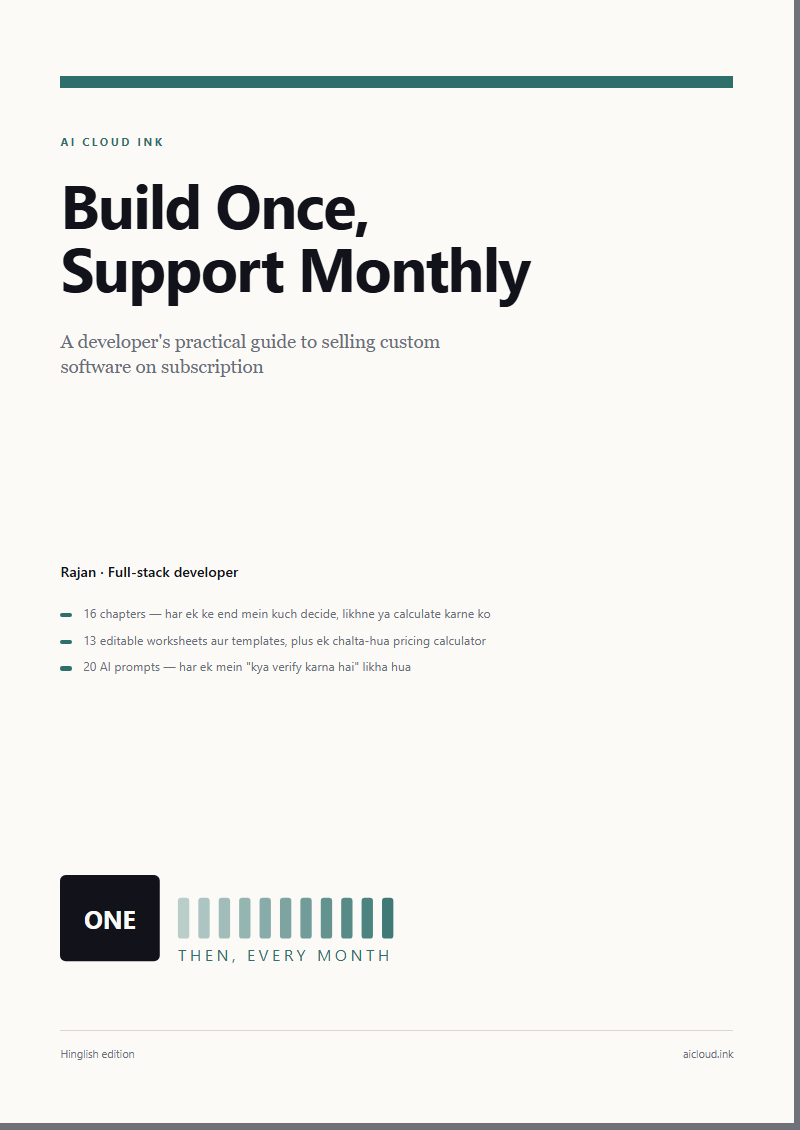
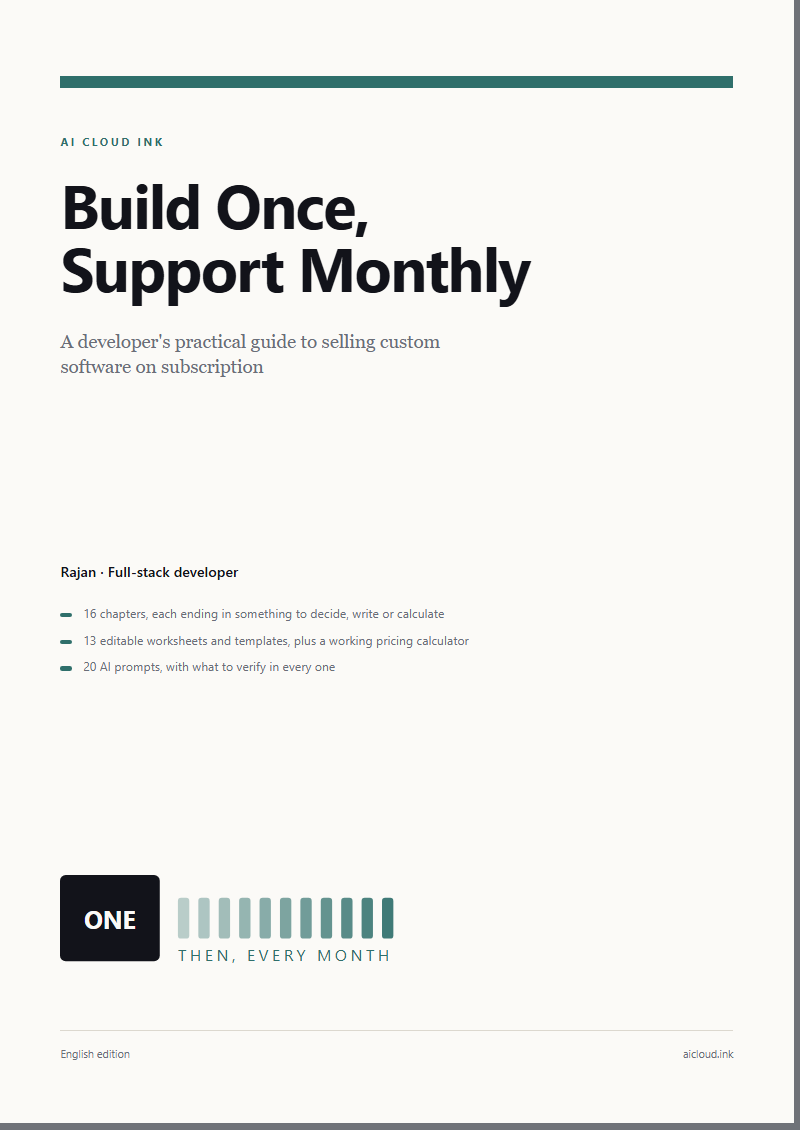
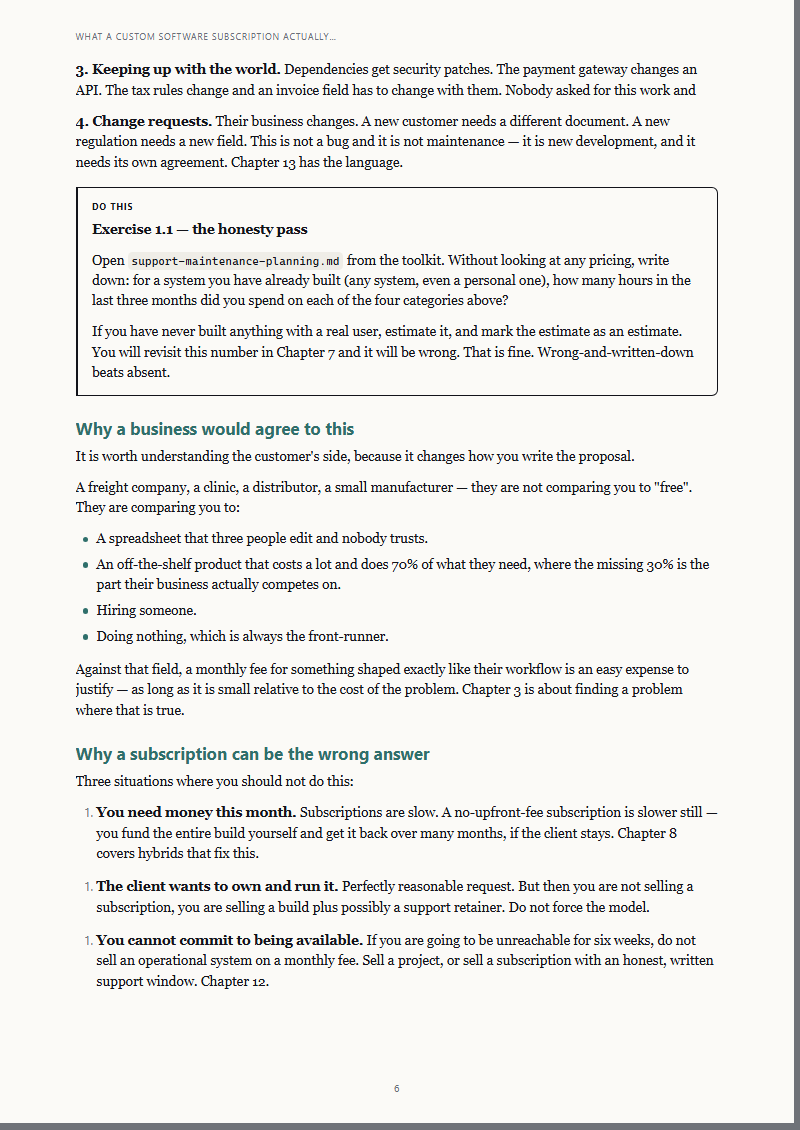
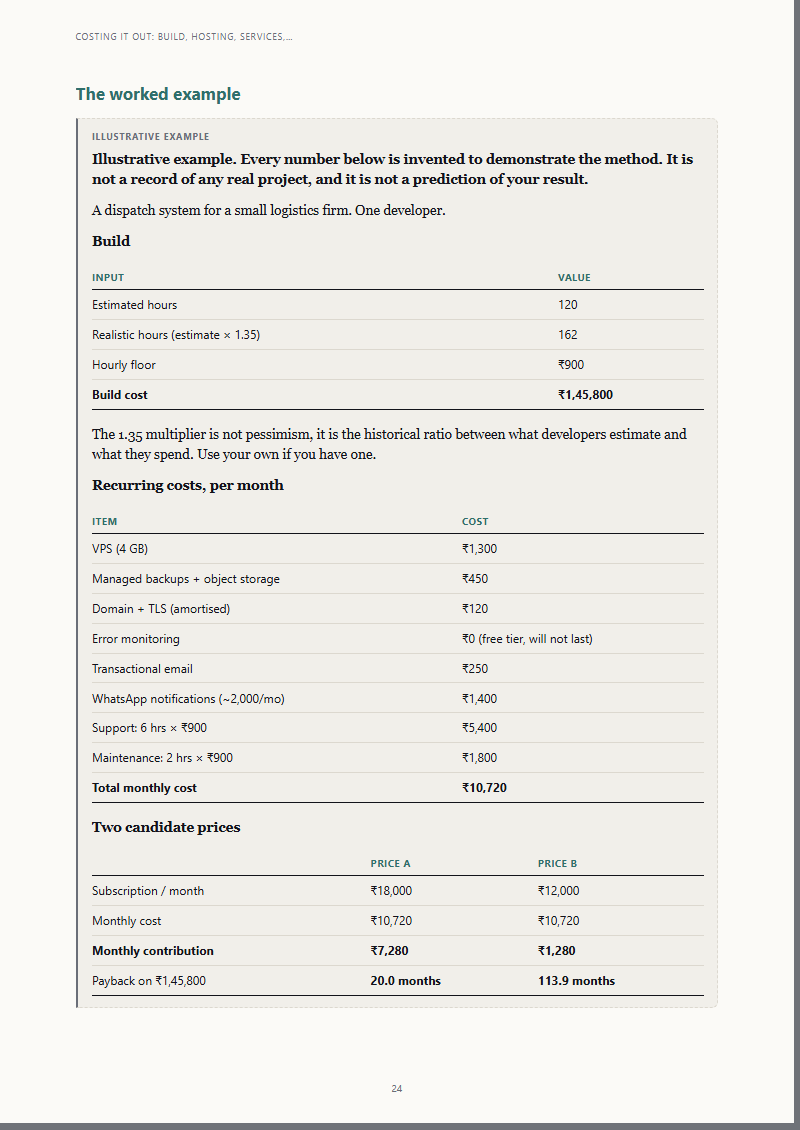
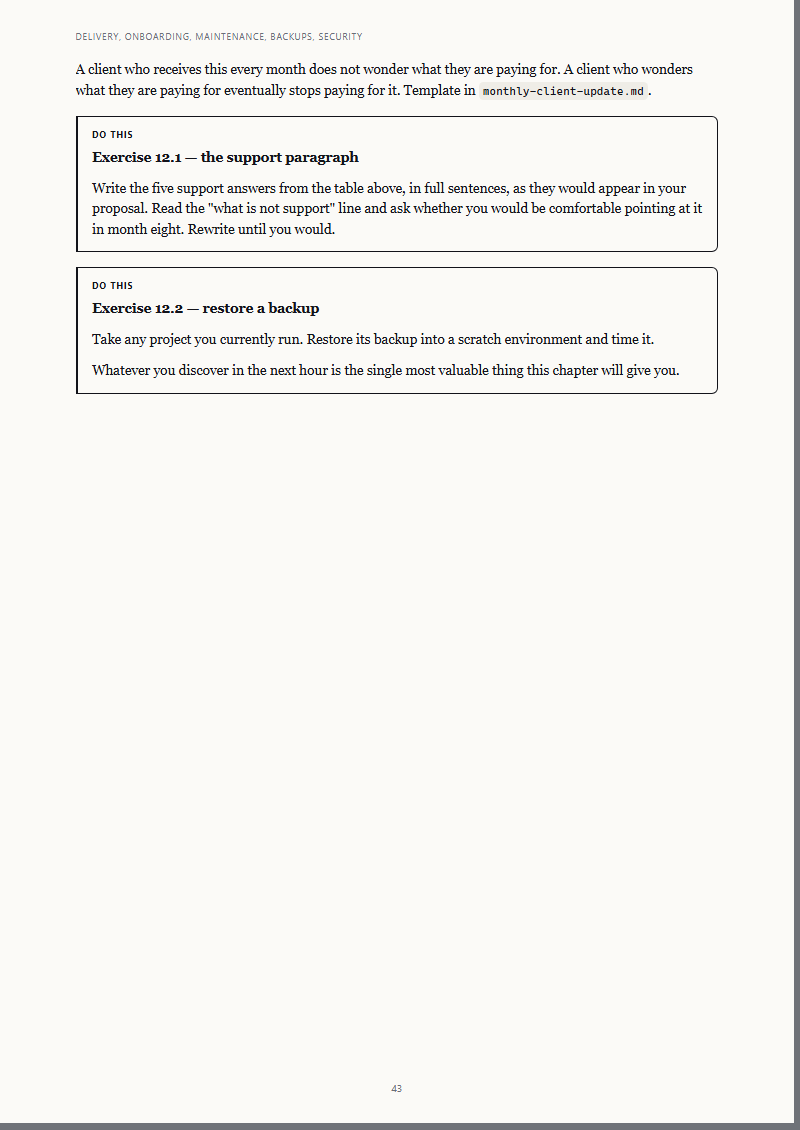
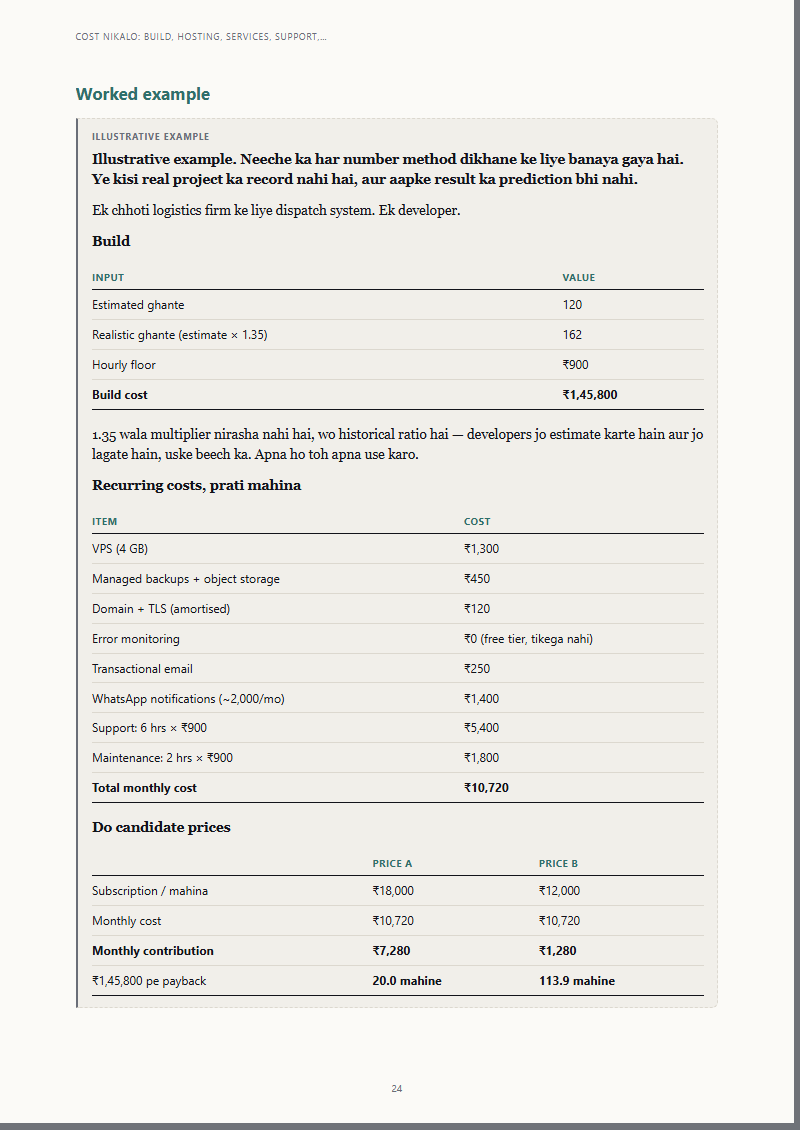
These are screenshots of the actual exported PDFs, not mockups. The two editions carry the same chapters, examples, numbers and exercises; a build check fails if a table or a figure goes missing from either one.
The toolkit
Thirteen tools you will actually open
Thirteen editable tools in plain Markdown and CSV, so they open in Excel, Google Sheets, Numbers, LibreOffice, Notion or Notepad — and nothing you write is trapped in a format you have to keep paying to open.
Customer discovery questionnaire
The full 45-minute script, with the probes for when they gloss over a step.
Business problem selection worksheet
Four gates and a 0–3 scoring grid across six criteria.
Competitor comparison sheet
One row per capability, with an Evidence column that forces "Unknown" when you cannot cite anything.
Proposal template
Nine sections, plus a completed illustrative example so the tone is visible.
Scope and exclusions checklist
The markup exercise, the cut test, and the out-of-scope list that has to be longer.
Demo meeting agenda
A minute-by-minute run sheet, the four objections, and what to write down while they talk.
Client onboarding checklist
Before launch, launch day, week one, week two, week four, and the 90-day re-price check.
Feature and change request template
Fault or change, impact, hours, and whether it adds a recurring cost.
Support and maintenance planning worksheet
The five support answers, a request log, and the escalations you decide in advance.
Monthly client update template
Nine lines, same day every month. Five minutes of work with the highest return in the book.
Outreach and follow-up examples
Six messages with notes on what to change and what to leave alone.
30-day implementation tracker
A row per day with dates, plus an experiment log with stop rules.
Subscription pricing calculator
The pricing calculator actually works
Open it in a browser, type your own numbers, and it shows you what the deal really is. It runs entirely on your machine — there is not one network request in the file.
- Monthly contribution, split into fixed cost, variable cost and your own time.
- Payback period on the build you are self-funding, net of any setup fee.
- Expected net across the lifetime implied by your churn assumption.
- A 5× growth stress test that shows whether growth turns the deal negative.
- The price that gives a 12-month payback, and the price where expected net is zero — your floor.
- When contribution is zero or negative it refuses to print a payback number and says why, instead of showing a large misleading figure.
The prompt pack
Twenty prompts that refuse to make things up
Twenty copy-ready prompts covering the whole arc: evaluating a niche, preparing and analysing interviews, extracting requirements, comparing competitors from evidence you supply, scoping, modelling economics, proposals, outreach, follow-ups, demos, scope negotiation, change requests, technical planning, code review, documentation, onboarding, support triage, monthly reporting and portfolio case studies.
- 1When to use it
- 2What to supply — these do not work without your facts
- 3The prompt, with placeholders in capitals
- 4Expected output, so you can tell whether it worked
- 5What you must verify — the part people skip
Every prompt carries the same guardrails
Each line is there because of a specific failure mode, explained in Chapter 14. Take them out and the model fills gaps silently and confidently, and you cannot tell which parts it invented.
RULES:
- Ask me for anything you need that I have not provided, before answering.
- Base your answer only on the information I have given you.
- Do not invent statistics, research, prices, benchmarks, vendor names or
  citations. If you do not have a fact, write UNKNOWN.
- List every assumption you made in a separate section at the end,
  labelled ASSUMPTIONS.
- Do not include any information that could identify my client.
Pricing
One purchase, everything in it
A one-time payment. Not a subscription — nothing recurring is set up, and no card is stored.
Both the English and the Hinglish edition are included in the same purchase. You do not choose one; you get both.
What you get
- English edition PDF
- Hinglish edition PDF
- 13-piece toolkit (worksheets, templates, checklists)
- Subscription pricing calculator with working formulas
- 20-prompt AI prompt pack
- Free updates to version 1.x
- Instant download
- Both editions included
- Not a subscription
- Free 1.x updates
Optional
Personal coaching
The book is complete on its own — every chapter, both editions, the toolkit and the prompt pack. Nothing has been held back to sell you this. The one thing a book cannot do is look at your specific situation.
₹5,000 per month. Manual monthly renewal — no card is stored and nothing auto-charges.
A separate purchase. You do not need the book to take it, and buying the book does not oblige you to consider it.
What people bring to it
- A proposal that has not been answered, and why
- Pricing a specific project, with your real numbers
- Scope that has started expanding, and how to have that conversation
- Which of three ideas to actually pursue
- Portfolio and positioning when you have few public projects
- Client communication that has gone quiet or gone wrong
- Freelancing-platform strategy, and when it is the wrong tool
- Technical decisions on a project you are mid-way through
- Building AI into your workflow without shipping its mistakes
- Structuring a software subscription offer for the first time
What it is not
- Not a guarantee of clients, projects or income. Nobody can offer that honestly.
- Not done-for-you development. You do the building.
- Not job placement, and not an agency pipeline.
- Not round-the-clock availability.
How it runs
- Sessions
- Two 45-minute calls a month, booked from open slots
- Between calls
- One WhatsApp thread — not a second channel to keep track of
- Response
- Acknowledged within one business day, Mon–Sat. That is an acknowledgement, not a fix.
- Renewal
- Manual. No card is stored, nothing auto-charges, and the month simply ends.
- Cancelling
- There is nothing to cancel. You do not renew.
Not open for enrolment yet
The session structure above is settled. Two things are not: how many people can be taken on at once, and whether the book is included for someone who has not already bought it. Enrolment stays closed until both are decided, rather than opening with terms that might change in a month. If you want to be told when it opens, get in touch.
The author
Who wrote this
Rajan
Full-stack developer
Rajan is a full-stack developer who builds custom business software. He built a transport management system for a freight company, sold as a $500 per month subscription with no separate upfront development fee, unlimited users and unlimited shipments, customised around that company's workflows.
That is one project, one client, and one price. It is not a track record, and this book does not present it as one. Where the book recommends a method, it says so. Where it runs numbers, they are invented and labelled. Where something is not known — build cost, margin, how long the payback took — it says that instead of filling the gap.
The reason to write a book this way is simple: you are going to make pricing decisions with real money based on what is in it, and a case study that flatters itself is worse than useless to you.
FAQ
Questions, answered straight
No. The book and toolkit are a one-time purchase at ₹499. No card is stored, nothing recurring is created, and you will not be charged again. Coaching is a separate offer at ₹5,000 per month and is not part of this purchase.
₹499 · one-time
Run the numbers before you name a price
Sixteen chapters, thirteen worksheets, a working calculator, twenty prompts, in two languages. One payment.
Get it — ₹499One-time purchase. Not a subscription. You are charged once.